You are planning a trip to Vietnam and are having
difficulties deciding where to go and what to do, what you
cannot miss and what to skip. From the feedbacks of our
customers, Tailormade Vietnam Holidays would like to recommend
some activities considered by travellers as must-do's when you
are in Vietnam....
read more

A glimpse of Quy Nhon
Visit
Quy Nhon at noon and you'll see the sunlight blanket the hills
that surround it, shimmer on its urban streets, and glisten on the
tip of each pristine wave that laps a nearby beach.
 Away from the noise
and bustle of Highway One, away from the crush of development, Quy
Nhon offers the peace and tranquility of bygone times. As I walk
down a side street I hear a song emanate from a radio and its lyrics
engrave the essence of Quy Nhon in my memory:"...Today the streets
are encased in sunlight, I am alone on an empty street. Far away,
waves sing softly the song of my longing for you...".
Away from the noise
and bustle of Highway One, away from the crush of development, Quy
Nhon offers the peace and tranquility of bygone times. As I walk
down a side street I hear a song emanate from a radio and its lyrics
engrave the essence of Quy Nhon in my memory:"...Today the streets
are encased in sunlight, I am alone on an empty street. Far away,
waves sing softly the song of my longing for you...".
I've been drawn to Quy Nhon for a long time. In my imagination, this
is the place of the ruined Do ban citadel from which the rulers of
Chiem Thanh city ruled unchallenged for so many years. In my mind I
can hear horses neighing and solider shouting as they fight the
deadly battles between Cham soldiers and those of the Vietnamese
dynasties that imposed their might from the north. Later, once the
area came under Vietnamese control, it gave birth to powerful
military heroes (Nguyen Nhac, Nguyen Hue and Nguyen Lu all hailed
from this region).
There were artists too. Van Cao, a famous poet, painter and
composer, came from here and wrote about the Cham towers that "take
cover under the blue sky". His poetry inspired me to visit some of
the towers, which draw thousands of tourists every year.
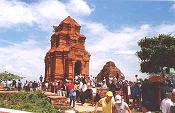
.jpg) The twin granite
towers in Thap Doi, just outside Quy Nhon, are as red as lipstick.
They're relatively small and are humbled by the powerful sunlight
that beats down on them, but they are unique from other towers in
one way: their creators were heavily influenced by Hindu
architecture and each tower is carved with Garudas, mythical birds
still revered in Indonesia. North of the towers are two bridges
where lovers have traditionally opened their hearts to each other
with poems like this:
The twin granite
towers in Thap Doi, just outside Quy Nhon, are as red as lipstick.
They're relatively small and are humbled by the powerful sunlight
that beats down on them, but they are unique from other towers in
one way: their creators were heavily influenced by Hindu
architecture and each tower is carved with Garudas, mythical birds
still revered in Indonesia. North of the towers are two bridges
where lovers have traditionally opened their hearts to each other
with poems like this:
Two towers stand together,
two bridges stand together,
So why can't I get close to you?
Like the Egyptian pyramids, no one knows how the Cham were able to
build these towers. Each brick was compacted tightly next to its
neighbor before another was added above, yet none were tied with
mortar. Without this glue, how did these monuments withstand the
test of time and survive hundreds of years of rain and heat? The
secret of their resilience increases their appeal.
Out of the city and along Highway One, four more beautiful towers
come into view. These are the Banh It towers, named after a type of
rice cake whose shape they resemble. The main tower is to the East
because the Cham believed that an island in South China Sea (known
in Vietnam
as the Eastern Sea) was home to their gods. From the
top of a nearby hill you can see each tower clearly. They are like
four sunbeams falling from the sky, each one mighty in its lonely
solitude.
Not far away are the Duong Long towers, a group of three exquisite
buildings. They stand close to each other, with the tallest reaching
36 meters (120 feet) into the sky and the others an impressive 29
meters (95 feet). Some say they are the most beautiful of all
remaining Cham towers, made so by the plethora of engravings that
depicts gods, dancing girls, elephants, dragons and nagas (mythical
snakes).
.jpg) Quy Nhon is the
capital of Binh Dinh province; know for its martial arts prowess.
But from here too have come poets. One of its best known was Han Mac
Tu, who died of leprosy in the early 20th century. I visited Quy Hoa
hospital where he ended his days in peaceful repose, creating his
life's last masterpieces. One night, as he gazed at the shimmering
moon, he wrote this tribute to love:
Quy Nhon is the
capital of Binh Dinh province; know for its martial arts prowess.
But from here too have come poets. One of its best known was Han Mac
Tu, who died of leprosy in the early 20th century. I visited Quy Hoa
hospital where he ended his days in peaceful repose, creating his
life's last masterpieces. One night, as he gazed at the shimmering
moon, he wrote this tribute to love:
Far away, a girl sits by the Nhan River washing silk dresses.
Water becomes the moon and the moon becomes water.
The silk is dampened by the watery moon.
The girl is wrapped in moonlight,
Only her cheekbones shine red.
I want to hold the moon in my arms,
I dream of the moon and pick at the moonlight.
.jpg) When Han Mac Tu
died, his remains stayed in Quy Nhon and his grave became a place of
pilgrimage for many people. I visited it at nightfall, as the fading
sunlight fell behind a mountain and splashed its dying golden rays
over the sea around Quy Nhon. It was to the sound of waves crashing
on these beaches that Tu was lulled into his unbreakable sleep.
Behind his grave a painter, Dzu Kha, engraves Tu's poems on wooden
palates for visiting tourists.
When Han Mac Tu
died, his remains stayed in Quy Nhon and his grave became a place of
pilgrimage for many people. I visited it at nightfall, as the fading
sunlight fell behind a mountain and splashed its dying golden rays
over the sea around Quy Nhon. It was to the sound of waves crashing
on these beaches that Tu was lulled into his unbreakable sleep.
Behind his grave a painter, Dzu Kha, engraves Tu's poems on wooden
palates for visiting tourists.
I had only a glimpse of Quy Nhon but I won't forget its pull; the
ancient moss-covered towers, the gentle sounds of Tu's resting place
in Gheng Rang, and the quiet rhythm of the sea.
Read more